Toolbox Talk Document Generator

Instantly Create Your Toolbox Talk document, Just enter your details

Recognising and Preventing Workplace Burnout Toolbox Talk

Use our toolbox talk generator to create customised workplace safety documents. Learn more about Recognising and Preventing Workplace Burnout Toolbox Talk Template below
Company:
Issue:
Approved:
Ver:

Loading Document Generator...

Please wait while we prepare your workspace

Go Digital with Electronic Signatures: Once you've saved your document, visit My Documents to create a secure share link. Distribute it across any platform (WhatsApp, Email, SMS) to collect encrypted digital signatures from your workforce and generate professional sign-off reports.

loading...

PLEASE WAIT DO NOT CLOSE THIS PAGE
YOUR DOCUMENT IS BEING GENERATED

Important: The documents produced by this tool are templates only. They must be reviewed and approved by a competent person or your HSEQ representative prior to publication or circulation, in accordance with our Terms & Conditions.

Still Using Paper Sign-Off Sheets?

Once you've generated and saved your document, create a secure share link to distribute across any platform. Collect encrypted digital signatures from your team and generate professional sign-off reports.

Generate
Save
Share
Sign
Report
Try It Free

Testing with increased limits

Toolbox Talk Description:

This toolbox talk equips supervisors and staff with practical steps to recognise and prevent workplace burnout, a significant psychosocial hazard. It explains how chronic stress affects physical health, mental wellbeing and safety performance, and links the issue to the HSE Management Standards for work‑related stress. The guide outlines legal duties under the Health and Safety at Work Act 1974 and the Management of Health and Safety at Work Regulations 1999, and provides actionable do’s such as regular risk assessments, realistic workload planning, confidential mental‑health support, manager training, enforced break periods, peer‑support programmes, physical environment improvements, workload reviews and resilience training. It also lists don’ts to avoid common pitfalls, including ignoring fatigue, assigning high‑risk tasks without assessment, stigmatising mental‑health help, excessive overtime, neglecting policy reviews, missing activity breaks, overlooking remote worker signs, relying on informal check‑ins, delaying interventions, and applying one‑size‑fits‑all solutions. The talk highlights the importance of regular supervision, line‑manager involvement in early detection, and integrating stress monitoring into existing health‑and‑safety audits. Additional resources include the HSE Management Standards workbook, the NHS mental wellbeing toolkit, and the CIPD stress at work guidance. Implementing these measures not only safeguards employee wellbeing but also supports organisational resilience, reduces costs associated with sick leave, and demonstrates a commitment to a safe and healthy workplace. HSE stress guidance and Health and Safety at Work Act 1974 provide further detail.

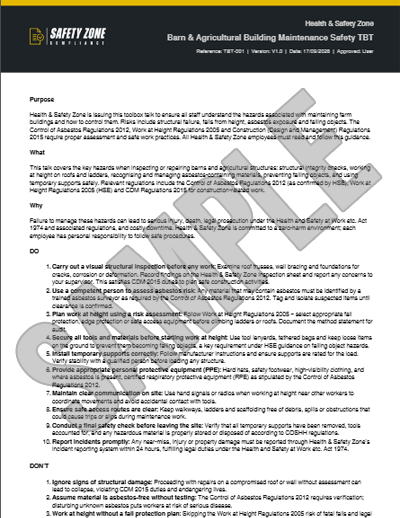
Sample PDF Document Image:
Frequently Asked Questions: