Toolbox Talk Document Generator

Instantly Create Your Toolbox Talk document, Just enter your details

Infection Control and Enhanced Cleaning Protocols Toolbox Talk

Use our toolbox talk generator to create customised workplace safety documents. Learn more about Infection Control and Enhanced Cleaning Protocols Toolbox Talk Template below
Company:
Issue:
Approved:
Ver:

Loading Document Generator...

Please wait while we prepare your workspace

Go Digital with Electronic Signatures: Once you've saved your document, visit My Documents to create a secure share link. Distribute it across any platform (WhatsApp, Email, SMS) to collect encrypted digital signatures from your workforce and generate professional sign-off reports.

loading...

PLEASE WAIT DO NOT CLOSE THIS PAGE
YOUR DOCUMENT IS BEING GENERATED

Important: The documents produced by this tool are templates only. They must be reviewed and approved by a competent person or your HSEQ representative prior to publication or circulation, in accordance with our Terms & Conditions.

Still Using Paper Sign-Off Sheets?

Once you've generated and saved your document, create a secure share link to distribute across any platform. Collect encrypted digital signatures from your team and generate professional sign-off reports.

Generate
Save
Share
Sign
Report
Try It Free

Testing with increased limits

Toolbox Talk Description:

This infection control and enhanced cleaning toolbox talk equips security, surveillance and public safety teams with practical, step‑by‑step guidance for keeping stations, stadiums, shopping centres, airports and other high‑traffic public venues hygienic. It covers chemical safety, slip prevention, ventilation, waste disposal and hand hygiene, referencing specific British Standards such as BS EN 374 gloves, BS EN 166 goggles, BS EN ISO 20345 footwear, BS EN 14476 virucidal efficacy, BS EN 14424 organic‑load testing, BS EN 1660 surface testing and BS EN 1500 hand‑rub performance.

Key actions include using pre‑measured disinfectant dispensers, applying the correct dilution, maintaining dry floors with wet‑floor signage, ensuring at least six air changes per hour, and securely storing chemicals. Staff are trained to read Safety Data Sheets and follow the documented cleaning schedule using digital checklists.

For further guidance see HSE’s cleaning overview https://www.hse.gov.uk/cleaning/ and the COSHH Regulations text https://www.legislation.gov.uk/ukpga/2002/33/contents. Additional best‑practice advice is available from NHS England’s infection prevention and control guidance https://www.england.nhs.uk/publication/national-infection-prevention-and-control/. Regular audits should be carried out to verify that PPE is worn correctly, dilution logs are accurate and ventilation measurements meet the required six air changes per hour. Use the digital checklist to record each cleaning task and retain records for at least 12 months to demonstrate compliance during inspections. Further guidance on risk assessments for cleaning chemicals can be found in HSE’s COSHH risk assessment handbook https://www.hse.gov.uk/pubns/books/risk.pdf.

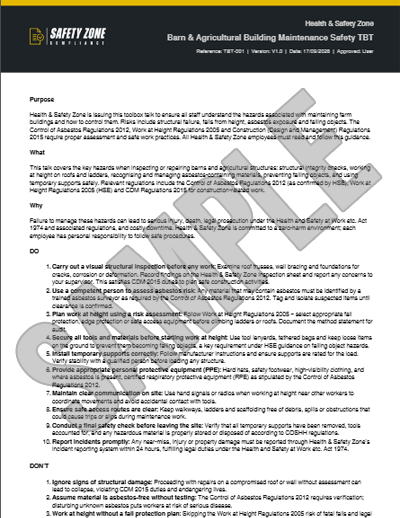
Sample PDF Document Image:
Frequently Asked Questions: