Please wait while we prepare your workspace
You've reached your limit.
0 / 0Please wait while we process your request
Generating your document and preparing download...
Company: -
Version: -
Issue Date: -
Approved By: -
Go Digital with Electronic Signatures: Once you've saved your document, visit My Documents to create a secure share link. Distribute it across any platform (WhatsApp, Email, SMS) to collect encrypted digital signatures from your workforce and generate professional sign-off reports.

PLEASE WAIT DO NOT CLOSE THIS PAGE
YOUR DOCUMENT IS BEING GENERATED
Once you've generated and saved your document, create a secure share link to distribute across any platform. Collect encrypted digital signatures from your team and generate professional sign-off reports.
Testing with increased limits
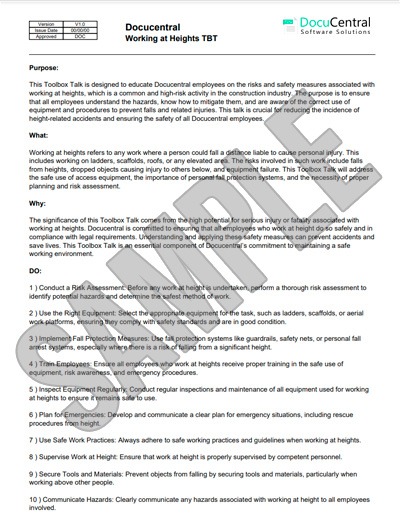
Working at Heights Toolbox Talk Template: Prioritising Safety Above Ground Level
The Working at Heights Toolbox Talk Template on our platform is a crucial tool for any organisation engaged in activities involving height. This template is expertly crafted to align with UK regulations and best practices, ensuring a comprehensive approach to safety in elevated work environments.
Key Features and Benefits of the Template
Enhancing Safety and Compliance
Streamlined Document Creation with Our Generator
Useful Resources and Links
A Toolbox talk on Working at Heights is essential to educate employees about the risks associated with tasks performed at elevated levels and to emphasize the importance of fall prevention measures to avoid accidents and injuries.
Common tasks include roof work, scaffolding, ladder use, and working on elevated platforms or structures. It’s crucial to identify specific tasks that pose fall hazards.
The talk should cover principles such as assessing the risks associated with the task, selecting the right equipment (e.g., safety harnesses, guardrails), maintaining a clear and stable work area, and ensuring proper training for employees working at heights.
Toolbox talks on this topic should be conducted regularly, particularly before starting tasks involving work at heights or when new equipment or procedures are introduced. The frequency may vary based on workplace conditions.
Employees should immediately report unsafe conditions or practices to their supervisor or safety officer. They should also stop work if necessary to ensure safety and prevent accidents.