Safe Specimen Handling Toolbox Talk: Essential Laboratory Safety Guidance
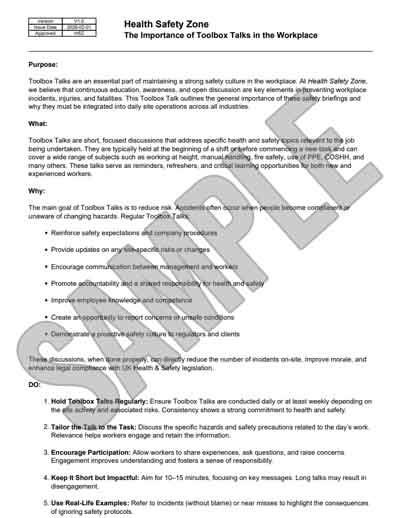
The Safe Specimen Handling Toolbox Talk template from Health & Safety Zone provides essential guidance on biological hazard control, COSHH compliance, and safe laboratory practices. Suitable for healthcare facilities, clinical laboratories, pathology services, and diagnostic centres, this toolbox talk helps workers understand how to prevent infection transmission, manage chemical exposure, and protect patient and staff safety in compliance with UK regulations.
Why Is Safe Specimen Handling Important?
Protects Workers: Proper specimen handling protocols prevent exposure to biological agents, infectious diseases, and hazardous chemicals, reducing the risk of laboratory-acquired infections and occupational illness.
Improves Productivity: Clear standard operating procedures and effective containment measures reduce spill incidents, minimise sample contamination, and ensure accurate diagnostic results, supporting efficient laboratory operations.
Compliance with Regulations: The Control of Substances Hazardous to Health (COSHH) Regulations 2002 requires employers to assess risks, implement control measures, and provide adequate training for handling hazardous biological specimens.
Key Benefits of the Toolbox Talk
Hazard Awareness: Covers biological hazards from blood-borne pathogens, tissue samples, and bodily fluids, as well as chemical risks from fixatives, reagents, and disinfectants.
Control Measures: Explains primary containment using leak-proof containers, biosafety cabinets for aerosol control, PPE selection, and decontamination procedures to prevent cross-contamination.
Emergency Response: Outlines spill response protocols, exposure reporting, and incident investigation procedures to ensure rapid and effective management of laboratory accidents.
Customisable for Any Workplace: Fully editable to address your organisation’s specific risk assessments and safety procedures.
Regulatory Compliance: Ensures alignment with UK health and safety laws for a legally compliant working environment.
Simplifying Toolbox Talk Creation with Our Online Generator
Health & Safety Zone’s online document generator allows you to customise this toolbox talk, tailoring it to your workplace’s unique hazards and safety goals.
Promoting a Proactive Safety Culture
Encourages Accountability: Reinforces individual responsibility for workplace safety.
Supports Continuous Improvement: Helps organisations learn from incidents to enhance safety measures.
Useful Resources and Links
Control of Substances Hazardous to Health Regulations 2002: https://www.legislation.gov.uk/uksi/2002/2677/pdfs/uksi_20022677_en.pdf
HSE Safe working and the prevention of infection in clinical laboratories: https://www.hse.gov.uk/pubns/books/clinical-laboratories.htm
HSE Provision of key clinical information on laboratory specimen request forms: https://www.hse.gov.uk/safetybulletins/clinicalinformation.htm