Toolbox Talk Document Generator

Instantly Create Your Toolbox Talk document, Just enter your details

Power Failure Security Procedures and Emergency Lighting Toolbox Talk

Use our toolbox talk generator to create customised workplace safety documents. Learn more about Power Failure Security Procedures and Emergency Lighting Toolbox Talk Template below
Company:
Issue:
Approved:
Ver:

Loading Document Generator...

Please wait while we prepare your workspace

Go Digital with Electronic Signatures: Once you've saved your document, visit My Documents to create a secure share link. Distribute it across any platform (WhatsApp, Email, SMS) to collect encrypted digital signatures from your workforce and generate professional sign-off reports.

loading...

PLEASE WAIT DO NOT CLOSE THIS PAGE
YOUR DOCUMENT IS BEING GENERATED

Important: The documents produced by this tool are templates only. They must be reviewed and approved by a competent person or your HSEQ representative prior to publication or circulation, in accordance with our Terms & Conditions.

Still Using Paper Sign-Off Sheets?

Once you've generated and saved your document, create a secure share link to distribute across any platform. Collect encrypted digital signatures from your team and generate professional sign-off reports.

Generate
Save
Share
Sign
Report
Try It Free

Testing with increased limits

Toolbox Talk Description:

This toolbox talk provides UK workplaces with a comprehensive, step‑by‑step guide to maintaining security and safety during an unexpected power failure. It explains the legal duty under Regulation 8 of the Workplace (Health, Safety and Welfare) Regulations 1992 and the Electricity at Work Regulations 1989 to provide suitable emergency lighting, referencing BS EN 1838 for illumination levels and BS EN 50172 for escape‑route lighting. The document outlines practical actions: immediate activation of battery‑backed emergency lighting, securing all entry points, notifying the security control centre, deploying BS EN 60598‑12‑22‑rated portable lanterns, conducting visual hazard sweeps, maintaining fire‑alarm backup, restricting movement to essential personnel, preparing evacuation routes, documenting the incident, testing lighting weekly, and verifying generator readiness. Additional recommendations include regular testing of backup power distribution panels, ensuring emergency exit signage remains illuminated, providing high‑visibility vests for low‑light work, conducting quarterly evacuation drills, and appointing an emergency‑lighting officer to oversee maintenance. Regular review of the emergency lighting system after any incident, and updating the risk assessment to reflect changes in site layout or equipment, further strengthens resilience. Staff should be reminded of the procedures during monthly safety briefings and any new hires must receive induction training on power failure protocols. Links to HSE emergency‑procedures guidance, the Workplace Regulations 1992 Reg 8, and the BS EN 1838 standard are included for quick reference. By following these robust controls, organisations can significantly reduce the risk of theft, personal injury and operational disruption during power outages.

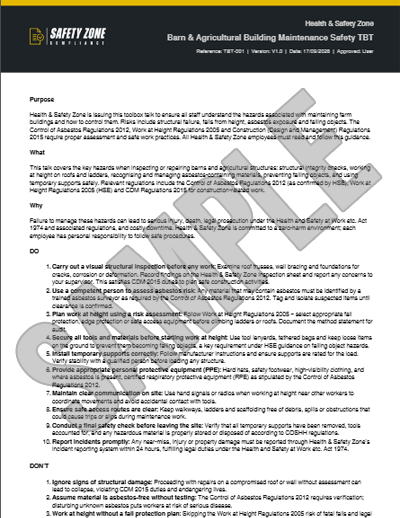
Sample PDF Document Image:
Frequently Asked Questions: