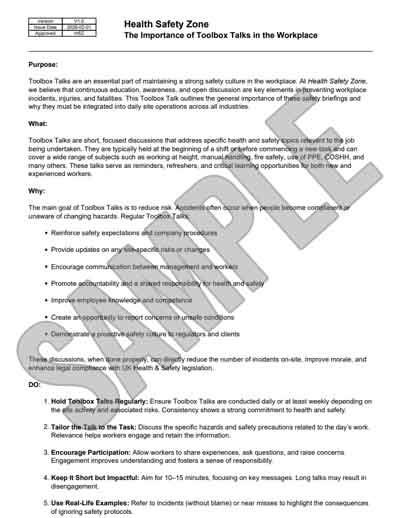
Patient Repositioning to Prevent Pressure Injuries Toolbox Talk: Essential Guidance for Safe Patient Care
The Patient Repositioning to Prevent Pressure Injuries Toolbox Talk template from Health & Safety Zone provides essential guidance on safe patient handling, pressure injury prevention, and regulatory compliance. Suitable for hospitals, care homes, nursing facilities, and community healthcare settings, this toolbox talk helps workers understand how to prevent pressure ulcers, reduce patient harm, and protect staff from manual handling injuries in compliance with UK health and safety regulations.
Why Is Patient Repositioning Important?
Protects Patients: Regular repositioning prevents pressure ulcers (also known as bedsores or pressure sores) which can cause severe tissue damage, infection, and prolonged patient suffering. Pressure injuries are largely preventable through proper repositioning techniques and risk assessment.
Protects Staff: Improper manual handling during patient repositioning can lead to musculoskeletal injuries, back pain, and long-term occupational health problems. Using correct lifting techniques and mechanical aids reduces workplace injuries and staff absence.
Compliance with Regulations: The Manual Handling Operations Regulations 1992 (as amended 2002) requires employers to avoid, assess, and reduce the risk of injury from manual handling. The Management of Health and Safety at Work Regulations 1999 requires risk assessments and safe systems of work.
Key Benefits of the Toolbox Talk
Hazard Awareness: Covers pressure injury risks, manual handling hazards, equipment failure, and inadequate repositioning frequency. Workers learn to identify high-risk patients and vulnerable pressure points such as heels, sacrum, and shoulders.
Control Measures: Details safe repositioning techniques, use of slide sheets, hoists, specialised mattresses, two-hour repositioning schedules, risk assessment procedures, and documentation requirements to ensure best practice and regulatory compliance.
Training and Competence: Emphasises the importance of staff training in patient handling, equipment use, and pressure injury prevention to meet legal duties under UK health and safety law.
Customisable for Any Workplace: Fully editable to address your organisation’s specific risk assessments, patient populations, equipment availability, and safety procedures.
Regulatory Compliance: Ensures alignment with Manual Handling Operations Regulations 1992, Management of Health and Safety at Work Regulations 1999, and Health and Safety at Work Act 1974 for a legally compliant healthcare environment.
Simplifying Toolbox Talk Creation with Our Online Generator
Health & Safety Zone’s online document generator allows you to customise this patient repositioning toolbox talk, tailoring it to your workplace’s unique patient care protocols, equipment types, and safety goals.
Promoting a Proactive Safety Culture
Encourages Accountability: Reinforces individual responsibility for patient safety and workplace safety among healthcare workers and care staff.
Supports Continuous Improvement: Helps organisations learn from pressure injury incidents and near misses to enhance patient care standards and safety measures.
Useful Resources and Links
Manual Handling Operations Regulations 1992 – Guidance on Regulations: https://www.hse.gov.uk/pubns/books/l23.htm
HSE Manual Handling at Work – The Law: https://www.hse.gov.uk/msd/manual-handling/the-law.htm
GOV.UK Safeguarding Adults Protocol – Pressure Ulcers: https://www.gov.uk/government/publications/pressure-ulcers-how-to-safeguard-adults/safeguarding-adults-protocol-pressure-ulcers-and-raising-a-safeguarding-concern