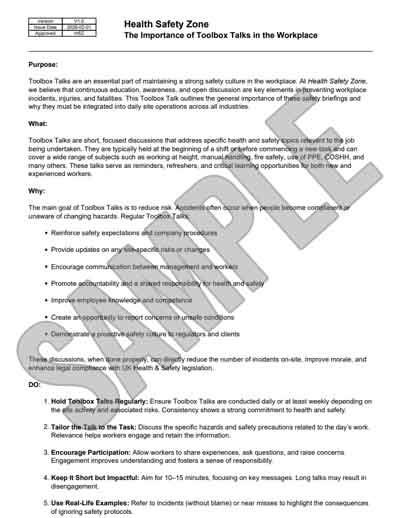
Ergonomics and Repetitive Strain Injury Prevention in Manufacturing Toolbox Talk: Protect Workers from Musculoskeletal Disorders
The Ergonomics and Repetitive Strain Injury Prevention in Manufacturing Toolbox Talk template from Health & Safety Zone provides essential guidance on preventing musculoskeletal disorders, upper limb disorders and repetitive strain injuries in manufacturing environments. Suitable for manufacturing, assembly, production, packaging and processing sectors, this toolbox talk helps workers and managers understand how to assess ergonomic risks, implement control measures and prevent workplace injuries in compliance with UK health and safety regulations.
Why Is Ergonomics and RSI Prevention Important?
Protects Workers: Proper ergonomics and repetitive strain injury prevention reduces the risk of chronic pain, carpal tunnel syndrome, tendonitis, back injuries and upper limb disorders, preventing long-term disability, sick leave and expensive compensation claims. Early intervention protects workers’ health and quality of life.
Improves Productivity: Well-designed workstations, ergonomic tools and appropriate rest breaks boost efficiency, reduce fatigue, improve work quality and enhance employee morale, leading to higher output and reduced errors in manufacturing operations.
Compliance with Regulations: The Manual Handling Operations Regulations 1992, Health and Safety (Display Screen Equipment) Regulations 1992, Provision and Use of Work Equipment Regulations 1998 and Management of Health and Safety at Work Regulations 1999 require employers to assess ergonomic risks, implement control measures, provide suitable equipment and ensure adequate training to prevent musculoskeletal injuries.
Key Benefits of the Toolbox Talk
Hazard Awareness: Identifies common ergonomic hazards including repetitive movements, awkward postures, forceful exertions, prolonged static positions, inadequate rest breaks and poorly designed workstations and tools that cause musculoskeletal disorders.
Control Measures: Recommends proven control measures such as adjustable workstations, ergonomic tool design, job rotation schedules, mechanical handling aids, micro-breaks, comprehensive training, early symptom reporting and regular risk assessments using the HSE Assessment of Repetitive Tasks tool.
Emergency Response: Outlines procedures for early symptom reporting, investigation of discomfort, workstation adjustments, medical referral and return-to-work support to prevent minor issues developing into chronic, disabling conditions.
Customisable for Any Workplace: Fully editable to address your organisation’s specific risk assessments, manufacturing processes, equipment types, task demands and safety procedures.
Regulatory Compliance: Ensures alignment with UK health and safety laws including the Health and Safety at Work etc Act 1974 and associated regulations, supporting legal compliance and demonstrating due diligence in managing ergonomic risks.
Simplifying Toolbox Talk Creation with Our Online Generator
Health & Safety Zone’s online document generator allows you to customise this toolbox talk, tailoring it to your workplace’s unique manufacturing hazards, repetitive tasks, equipment requirements and safety goals, creating professional, regulation-compliant health and safety documentation.
Promoting a Proactive Safety Culture
Encourages Accountability: Reinforces individual responsibility for workplace safety, correct posture, equipment adjustment, symptom reporting and compliance with safe systems of work.
Supports Continuous Improvement: Helps organisations learn from symptom reports, sickness absence data and incident investigations to enhance ergonomic controls, improve workstation design and prevent recurrence of musculoskeletal injuries.
Useful Resources and Links
Manual Handling Operations Regulations 1992: https://www.legislation.gov.uk/uksi/1992/2793/contents/made
Health and Safety (Display Screen Equipment) Regulations 1992: https://www.legislation.gov.uk/uksi/1992/2792/contents/made
Manual Handling – Guidance on Regulations (L23): https://www.hse.gov.uk/pubns/books/l23.htm
Ergonomics and Human Factors at Work (INDG90): https://www.hse.gov.uk/pubns/indg90.htm
Managing Upper Limb Disorders in the Workplace: https://www.hse.gov.uk/pubns/indg171.htm
Assessment of Repetitive Tasks (ART) Tool: https://www.hse.gov.uk/msd/uld/art/index.htm
Upper Limb Disorders: https://www.hse.gov.uk/msd/uld/index.htm