Please wait while we prepare your workspace
You've reached your limit.
0 / 0Please wait while we process your request
Generating your document and preparing download...
Company: -
Version: -
Issue Date: -
Approved By: -
Go Digital with Electronic Signatures: Once you've saved your document, visit My Documents to create a secure share link. Distribute it across any platform (WhatsApp, Email, SMS) to collect encrypted digital signatures from your workforce and generate professional sign-off reports.

PLEASE WAIT DO NOT CLOSE THIS PAGE
YOUR DOCUMENT IS BEING GENERATED
Once you've generated and saved your document, create a secure share link to distribute across any platform. Collect encrypted digital signatures from your team and generate professional sign-off reports.
Testing with increased limits
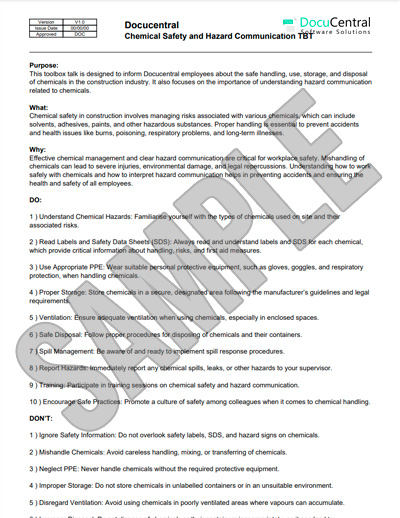
Chemical Safety and Hazard Communication Toolbox Talk Template: A Key to Safe Chemical Handling in the Workplace
The Chemical Safety and Hazard Communication Toolbox Talk Template from The Health & Safety Zone is an indispensable tool for UK companies committed to ensuring the safe handling and use of chemicals in the workplace. This professionally designed document template is perfect for conducting insightful and effective toolbox talks on chemical safety and hazard communication.
Key Features and Benefits of the Template
Enhancing Chemical Safety in the Workplace
Simplified Document Creation with Our Online Generator
Useful Resources and Links
A Toolbox talk on Chemical Safety and Hazard Communication is essential to educate employees about the risks associated with chemical exposure in the workplace and to emphasize the importance of understanding chemical labels, safety data sheets (SDS), and safe handling procedures.
Common hazards include exposure to toxic chemicals, corrosive substances, flammable materials, and hazardous reactions. The talk should help employees identify chemical hazards specific to their workplace.
Employees should understand how to interpret chemical labels, including hazard symbols, product names, and hazard statements. They should also know how to access SDS and find information on chemical composition, handling precautions, and emergency response procedures.
Toolbox talks on this topic should be conducted regularly, especially when employees are working with new chemicals or in environments with chemical hazards. The frequency may vary based on workplace conditions.
Employees should know the proper procedures for responding to chemical spills or exposures. This may include evacuating the area, notifying a supervisor, seeking medical attention if necessary, and following the appropriate spill cleanup protocols outlined in the SDS.