
Generate Risk Assessments in 4 Easy Steps: Complete the assessment details below, then add risks from our pre-populated library or create custom ones. Add your logo and signatures, save your document, then share it with staff and workers to collect electronic signatures—ensuring everyone has read and understood the risk assessment. Export to PDF anytime!
Assessment Details
Loading Risk Assessment Generator...
Please wait while we prepare your workspace
Free Generator Allowance
Checking your remaining document generations…
Documents today— / —
Upgrade for More
Warning: Once you proceed to the next step, these details will be locked. Changing these details after will count towards your generation quota. Please ensure accuracy before continuing.
Note: Once you have saved the document to your account, you will be able to edit and make changes at any time from your dashboard.
Risk Assessments
How to add risks: Use Add from Library for pre-written templates, or Add Custom to write your own.
Choose what goes in the document: Every risk is included by default — untick the box on any you don't want in the document.
Edit a risk: Click anywhere on the row to expand it and edit the details — ticked or unticked, both can be edited.
Step 1 must be completed before you can manage and edit the risks. Fill in the assessment details on Step 1 and click Next Step to unlock.
No risks added yet. Add risks from the library or create custom risks.
PLEASE WAIT DO NOT CLOSE THIS PAGE YOUR DOCUMENT IS BEING GENERATED
Important: The documents produced by this tool are templates only. They must be reviewed and approved by a competent person or your HSEQ representative prior to publication or circulation, in accordance with our Terms & Conditions.
Preparing Your Document
Generating your document and preparing download...
100%
Add Risk from Library
Risk
Initial Risk
Controlled Risk
Action
Accessibility and Accommodation for Disabilities (Healthcare)
12
4
Adverse Weather Conditions (Traffic Management)
12
4
Anesthetic Gases
12
4
Asbestos Exposure
20
5
Battery Acids (Lead-acid Batteries) Exposure
12
4
Biological Hazards
12
4
Cargo Theft
16
8
Cement Dust Exposure
16
4
Chemical Exposure
16
4
Chemical Exposure
12
4
Cold Stress
12
4
Compliance with Transportation Regulations
16
8
Confidentiality Breaches
12
4
Confined Spaces
15
5
Cross-border Transportation Challenges
12
8
Cybersecurity Threats in Fleet Management Systems
20
10
Digging near underground pipes, cables and equipment
10
10
Driver Fatigue Among Subcontracted Drivers
20
5
Driver Licensing and Certification Risks
16
8
Dust/Fume Inhalation
15
5
Economic and Market Volatility
16
8
Electrical Hazards
15
5
Electrical Hazards (Traffic Management)
15
5
Electrical Safety
15
5
Electrical Safety (Healthcare)
2
2
Emergency Vehicle Access (Traffic Management)
15
10
Environment Spillages/Use of Hazardous Substances, Use of Concrete
12
4
Environmental Conditions and Natural Disasters
12
8
Equipment Failure
12
4
Ergonomic Injuries
12
3
Excavation Work/Collapse of Excavation
15
5
Exposure to Infectious Diseases
20
20
Extreme Weather Conditions
12
4
Falling Objects
20
10
Fire
15
5
Fuel (Diesel and Petrol) Exposure
15
5
Fuel Price Fluctuation and Management
12
6
General Site Working, Access to the Work
15
5
HAVS
12
4
Health and Safety Risks in Warehousing and Material Handling
16
8
Health Crises and Pandemics
20
10
Heat Stress
12
4
HGV Overloading
12
4
Improper Waste Disposal (Healthcare)
12
4
Inadequate Infection Control
20
5
Inadequate Traffic Control Measures
20
10
Inadequate Vehicle Servicing and Maintenance
16
4
Inadequate Worker Training and Supervision
16
4
Incorrect Cargo Loading
16
8
Insufficient Site Security
12
4
Insurance and Liability Issues with Subcontracted Drivers
15
5
Isocyanates Exposure
16
4
Lack of Emergency Preparedness
15
5
Lack of Emergency Preparedness (Healthcare)
15
5
Lack of Training (Traffic Management)
16
8
Lack of Training and Familiarisation for Subcontracted Drivers
16
4
Laser Hazards (Healthcare)
12
4
Lead-Based Paint Exposure
15
5
Legal and Regulatory Changes
12
4
Manual Handling
12
4
Manual Handling (Traffic Management)
12
4
Mechanical Failures Leading to Road Incidents
15
5
Medical Equipment Malfunction
12
4
Mental Health and Stress
16
8
Mercury Exposure
15
5
Miscommunication Among Team Members
16
8
Miscommunication and Coordination Failures in Management
12
3
Mobile Phone Use on Site
15
5
Mould Exposure
12
3
Moving/Use of Plant and Machinery, Re-fuelling of Plant
15
5
Needlestick Injuries
12
4
Night Work (Roadworks)
16
8
Night Work and Reduced Visibility
16
8
Noise Exposure
12
4
Noise Exposure (Roadworks)
12
6
Noise Pollution
12
3
Non-Compliance with LGV Regulations
20
5
Patient Allergies and Specific Needs
15
5
Patient Elopement
12
4
Patient Handling
16
8
Personal Protective Equipment (PPE) Non-Compliance
16
4
Pharmaceutical Errors
15
5
Plant and Machinery Operation
12
4
Polychlorinated Biphenyls (PCBs) Exposure
15
5
Poor Lighting
12
3
Psychological Stress from High-Risk Environment
12
8
Psychosocial Risks
12
4
Public Interference
12
4
Radiation Exposure
10
5
Radiation Exposure (Healthcare)
12
4
Refrigerants (Freon, Ammonia) Exposure
12
4
Scaffolding Collapse
15
5
Silica Dust Exposure
20
5
Slips, Trips and Falls, Poor Housekeeping
16
4
Slips, Trips, and Falls (Healthcare)
9
3
Slips, Trips, and Falls (Traffic Management)
12
4
Solvent Exposure
12
4
Stress and Mental Health Issues
12
4
Struck by Moving Equipment
12
4
Structural Collapse
15
5
Subcontractor Compliance and Safety Standards
12
4
Supply Chain Disruptions
16
8
Sustainability and Environmental Impact (Fleet & Logistics)
12
4
Talent Acquisition and Retention
12
4
Tool Misuse and Malfunction
16
4
Traffic Accidents
20
5
Traffic Delays and Public Frustration
12
8
Traffic Management (Roadworks)
16
8
Use of Electric Leads/Power Tools
15
5
Use of Hand Tools
9
3
Use of Sthil Saw/Abrasive Wheels
15
5
Vehicle Accidents Due to Driver Fatigue
20
10
Vehicle Collisions (Roadworks)
20
10
Vehicle Collisions (Traffic Management)
20
10
Vehicle Defects Leading to Accidents
15
5
Vehicle Incursions into Work Zones
20
10
Water and Flooding
12
8
Water Hazards
12
4
Worker Fatigue
9
3
Working at Height
15
5
Working on National Highways
15
5
Working on National Highways under adverse weather conditions
10
10
Workplace Violence (Healthcare)
12
4
No templates found matching your filters.
Rebuild from template
Choose how to handle risks that already exist in this assessment.
Add missing onlyRestore risks you've deleted, without overwriting any edits to your existing risks. Recommended.
Reset everythingReplace every risk with the original template content. Any edits will be lost. Custom-added risks are kept.
Add Signature
Please sign in the box below:
PDF Preview
100%
Creating preview
Building your PDF preview…
Still Using Paper Sign-Off Sheets?
Once you've generated and saved your document, create a secure share link to distribute across any platform. Collect encrypted digital signatures from your team and generate professional sign-off reports.
Blow moulding risk assessment is designed for manufacturing operatives, machine operators, maintenance staff and process workers who work on plastic or rubber blow‑moulding lines in a factory setting. It covers the full cycle – from loading polymer granules, heating and extrusion, to forming the parison, inflating it inside the mould, cooling, ejection and post‑process handling. The assessment identifies the principal hazards associated with high‑temperature equipment, high‑pressure air systems, moving machine parts, chemical exposure and manual handling, and provides clear, actionable control measures that meet UK legislation.
The template is suitable for use in any blow‑moulding operation, whether producing bottles, containers, automotive components or technical parts. It aligns with the Provision and Use of Work Equipment Regulations 1998 (PUWER) for machine guarding and safe isolation, the Control of Substances Hazardous to Health Regulations 2002 (COSHH) for polymer additives and cleaning agents, and HSE manufacturing guidance on noise, vibration and thermal stress. Use it for risk planning, worker briefings and compliance documentation.
Use this template for:
Risk assessments of blow‑moulding processes in plastics or rubber factories.
Developing safe work procedures and training materials for machine operators.
Compliance checks against PUWER, COSHH and HSE manufacturing guidance.
Compliant with: PUWER 1998, COSHH 2002, Health and Safety at Work etc. Act 1974, and relevant HSE guidance on machinery safety, noise and vibration, and thermal stress. The template is fully editable and shareable, and can be customised to suit specific product lines, machine configurations, and site‑specific requirements.
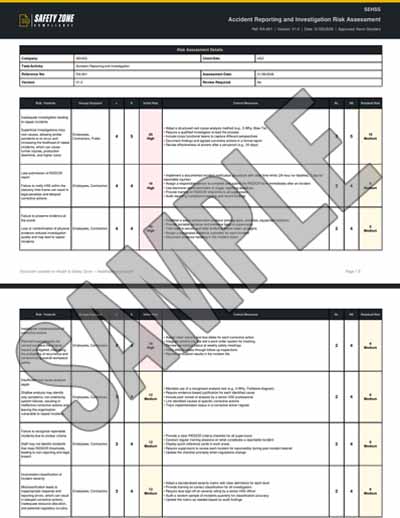
Sample PDF Document Image:
Risks covered in this Blow Moulding risk assessment
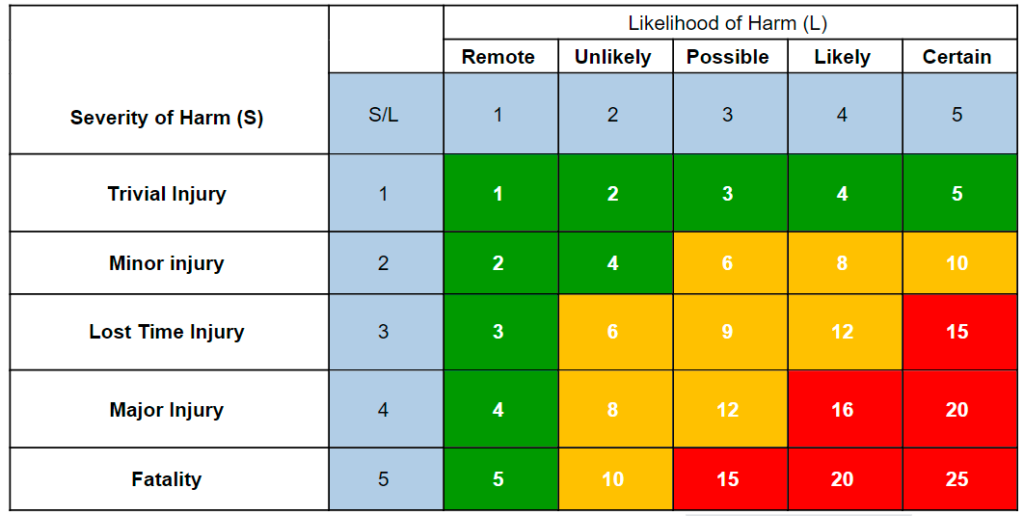
This Blow Moulding risk assessment template covers 15 assessed hazards, each scored before and after control measures on a 5×5 HSE risk matrix.
Hazard
Initial risk
Controlled risk
Moving machine parts – crushing and entanglement
20
10
Lock‑out/Tag‑out non‑compliance
20
10
Hot mould surface – burns and scalds
16
8
Interlock failure – unexpected mould opening
15
5
High‑pressure air injection – explosion or projectile
15
5
Electrical hazards during maintenance
15
5
Chemical exposure – polymer additives and cleaning solvents
12
4
Manual handling of heavy moulds and parisons
12
6
Thermal stress – heat stress in hot shop
12
4
Fire risk from overheating equipment
10
5
Air‑line leaks – noise and sudden discharge
9
3
Noise exposure from blow‑moulding machines
9
3
Polymer dust inhalation
9
3
Coolant or water spills – slip and trip hazards
8
4
Hand‑arm vibration from handheld tools
6
3
Frequently asked questions
Are these risk assessment templates really free to download?
Yes — completely free. Over 1400 free UK risk assessment templates, free to use forever, no signup required for guests, no paywall. Customise to your workplace and download as a professional HSE-compliant PDF in minutes.
Can I download risk assessment templates in PDF or Word format?
Risk assessments download as a professional, HSE-compliant PDF — ready to print and file as-is. Word (.docx) export is not available for risk assessments, but you can fully customise every hazard, control measure, persons-at-risk entry and rating online before you download.
Are the risk assessment templates HSE-compliant?
Yes. Every template aligns with HSE guidance and the HSE 5-Step Risk Assessment process. They cover the requirements of the Management of Health and Safety at Work Regulations 1999, COSHH 2002, Manual Handling Operations Regulations 1992, Work at Height Regulations 2005, and other relevant UK regulations.
What industries do the risk assessment templates cover?
Over 1400 templates across every UK industry — painting, electrical, HVAC, plumbing, carpentry, concrete, solar panel installation, asbestos, scaffolding, working at height, manual handling, fall protection, hot works, confined space entry, lifting operations, kitchen fitting, plumbing, drywall, tiling, plastering, and many more.
What's the difference between a risk assessment form and a risk assessment template?
A risk assessment form is the blank document; a risk assessment template is a pre-filled form ready to customise. Our generator gives you both — a free interactive form you fill in plus over 1400 pre-written templates you can customise to your specific workplace.
Do I need to create an account to use the risk assessment templates?
No — guests can generate and download risk assessments for free without signing up. Register a free account if you want to save documents to your dashboard, edit them later, or share them for digital signatures.
Can I customise the risk assessment templates to my workplace?
Yes — fully. Edit hazards, control measures, persons at risk, likelihood and severity ratings, PPE requirements, and review schedules. Each template is a starting point you tailor to your specific operation.
How many risks can I add to a single risk assessment?
The number of risks (hazards) you can include in one assessment depends on your plan: guests get unlimited risks, Free accounts unlimited risks, Standard unlimited risks, Pro unlimited risks, and Enterprise unlimited risks per assessment. You can add and preview every risk in a template, then tick the ones to include up to your plan limit — upgrade any time for more. See our pricing page for the full plan comparison.
Are these risk assessment templates valid for UK construction work?
Yes. Our construction-specific risk assessment templates align with HSE construction guidance, the Construction (Design and Management) Regulations 2015 (CDM 2015), and the Work at Height Regulations 2005. Templates cover scaffolding, working at height, concrete pouring, excavation, roofing, electrical installation, and more.
How often should I update my risk assessment?
Whenever there is reason to believe the assessment is no longer valid — after workplace changes, near-misses, accidents, new equipment, new substances, or new processes. HSE guidance recommends an annual formal review at minimum.
What is the HSE 5-step risk assessment process?
Step 1: Identify the hazards. Step 2: Decide who might be harmed and how. Step 3: Evaluate the risks and decide on precautions. Step 4: Record findings and implement them. Step 5: Review the assessment and update if necessary. Our interactive generator walks you through all 5 steps.
Can I use these risk assessment templates for self-employed work?
Yes. Self-employed workers are required to assess risks to themselves and anyone affected by their work. Our templates are suitable for sole traders, contractors, and small businesses.
Do you have RIDDOR-aligned risk assessment templates?
Yes. Several templates cover RIDDOR (Reporting of Injuries, Diseases and Dangerous Occurrences Regulations 2013) requirements — including accident reporting and investigation risk assessments. All RA templates support incident logging and review.