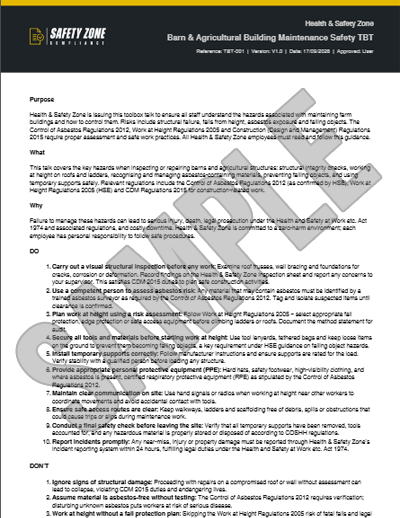
Safe Patient Transport Within Clinical Settings Toolbox Talk: Essential Guidance for Healthcare Professionals
The Safe Patient Transport Within Clinical Settings Toolbox Talk template from Health & Safety Zone provides essential guidance on risk assessment, equipment selection and safe manual handling practices. Suitable for hospitals, care homes, clinics and all healthcare facilities, this toolbox talk helps workers understand how to transport patients safely whilst minimising injury risk in compliance with UK health and safety regulations.
Why Is Safe Patient Transport Important?
Protects Workers: Reduces the risk of musculoskeletal injuries, back strain and workplace accidents amongst healthcare staff who regularly move patients between wards, radiology departments and operating theatres.
Improves Productivity: Proper patient handling techniques and use of mechanical aids enable staff to work more efficiently whilst maintaining high standards of patient dignity and clinical safety.
Compliance with Regulations: The Manual Handling Operations Regulations 1992 and Health and Safety at Work etc Act 1974 require employers to assess risks, avoid hazardous manual handling where possible and provide adequate training to all personnel involved in patient transport.
Key Benefits of the Toolbox Talk
Hazard Awareness: Covers key hazards including patient falls, equipment failure, infection control breaches and environmental risks such as wet floors and narrow corridors.
Control Measures: Details practical controls including pre-move risk assessments, use of slide sheets, hoists and wheeled stretchers, proper patient securing techniques and effective team communication protocols.
Emergency Response: Outlines procedures for monitoring patient vital signs during transfer, responding to discomfort signals and reporting near-misses to support continuous improvement in patient safety.
Customisable for Any Workplace: Fully editable to address your organisation’s specific risk assessments, equipment inventory and local safety procedures.
Regulatory Compliance: Ensures alignment with MHOR, HSWA, PUWER and the Management of Health and Safety at Work Regulations 1999 for a legally compliant working environment.
Simplifying Toolbox Talk Creation with Our Online Generator
Health & Safety Zone’s online document generator allows you to customise this toolbox talk, tailoring it to your workplace’s unique patient handling challenges, staffing levels and clinical safety goals.
Promoting a Proactive Safety Culture
Encourages Accountability: Reinforces individual responsibility for workplace safety, equipment inspection and colleague support during complex patient moves.
Supports Continuous Improvement: Helps healthcare organisations learn from incidents and near-misses to enhance manual handling training and update safety procedures.
Useful Resources and Links
Manual Handling Operations Regulations 1992: https://www.legislation.gov.uk/uksi/1992/2793/made
HSE Moving and Handling in Health and Social Care: https://www.hse.gov.uk/healthservices/moving-handling/index.htm
HSE Manual Handling at Work Guidance: https://www.hse.gov.uk/msd/manual-handling/index.htm