Toolbox Talk Document Creator

Instantly Create Your Toolbox Talk document, Just enter your details

Duty of Care When Dealing with Missing or Distressed Persons – Toolbox Talk

Use our toolbox talk generator to create customised workplace safety documents. Learn more about Duty of Care When Dealing with Missing or Distressed Persons – Toolbox Talk Template below
Company:
Issue:
Approved:
Ver:

Loading Document Generator...

Please wait while we prepare your workspace

Go Digital with Electronic Signatures: Once you've saved your document, visit My Documents to create a secure share link. Distribute it across any platform (WhatsApp, Email, SMS) to collect encrypted digital signatures from your workforce and generate professional sign-off reports.

loading...

PLEASE WAIT DO NOT CLOSE THIS PAGE
YOUR DOCUMENT IS BEING GENERATED

Important: The documents produced by this tool are templates only. They must be reviewed and approved by a competent person or your HSEQ representative prior to publication or circulation, in accordance with our Terms & Conditions.

Still Using Paper Sign-Off Sheets?

Once you've generated and saved your document, create a secure share link to distribute across any platform. Collect encrypted digital signatures from your team and generate professional sign-off reports.

Generate
Save
Share
Sign
Report
Try It Free

Increased Limits Available

Toolbox Talk Description:

This toolbox talk equips security and public‑safety teams with the legal duties and practical steps required when encountering missing or distressed individuals. It covers risk assessment under the Management of Health and Safety at Work Regulations 1999, reporting obligations from the Guardianship (Missing Persons) Act 2017, and de‑escalation techniques aligned with the Equality Act 2010. The guide details the use of BS EN‑standard personal alarms, BS EN 12644 emergency lighting, and the creation of a secure safe holding area. It also highlights the importance of data protection under UK GDPR, regular scenario‑based drills, and continuous improvement through post‑incident reviews. The procedures should be reviewed annually and after any significant incident to ensure ongoing compliance and continuous improvement. All staff must be familiar with these protocols to maintain a safe environment. The talk also references the Health and Safety at Work Act 1974, the Management of Health and Safety at Work Regulations 1999, and the Fire Safety Order 2005 where relevant, providing step‑by‑step guidance on assessment, communication, documentation, and follow‑up actions. By embedding these practices, organisations can demonstrate compliance during HSE inspections and protect vulnerable individuals. HSE lone‑working guidance, HSE incident response guidance, Guardianship (Missing Persons) Act 2017, Equality Act 2010 provide further detail.

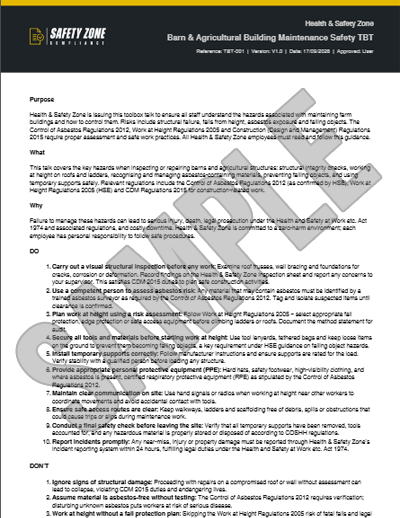
Sample PDF Document Image:
Frequently Asked Questions: